

Femoroacetabular Impingement (FAI) Syndrome
- What is femoroacetabular impingement syndrome and what are its clinical features?
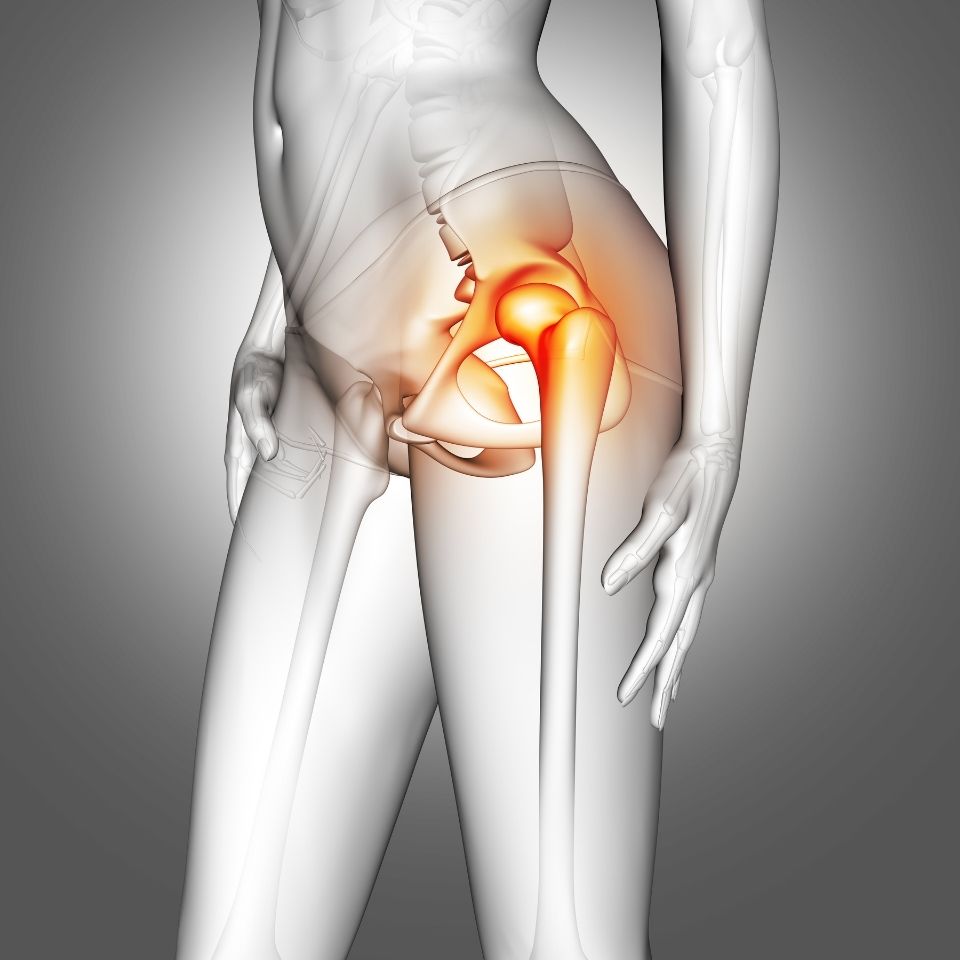
Femoroacetabular impingement (FAI) is a condition where damage develops as a result of the friction between the femoral head and the rim of the acetabulum (the socket of the hip joint). This damage typically remains painless until it injures the labrum, a cartilage-like structure surrounding the acetabulum.
Pain increases with certain movements and decreases with others. Over time, the patient may find it difficult to perform everyday activities such as crossing the legs, bending down, or sitting in low chairs.
Lindman I, Nikou S, Öhlin A, Senorski EH, Ayeni O, Karlsson J, Sansone M. Evaluation of outcome reporting trends for femoroacetabular impingement syndrome- a systematic review. J Exp Orthop. 2021
- How is femoroacetabular impingement diagnosed?
Diagnosis is primarily made through physical examination techniques supported by radiologic imaging. Since many conditions can cause hip pain, it is crucial to confirm through clinical tests that the pain originates from FAI.
Various specific tests are applied to identify the pain source. Subsequently, direct radiographs are taken, and to evaluate the extent of damage to bone, cartilage, and labrum, advanced imaging such as magnetic resonance imaging (MRI) and 3D computed tomography (CT) are utilized.
-
Chamberlain R. Hip Pain in Adults: Evaluation and Differential Diagnosis. Am Fam Physician. 2021
-
Schmaranzer F, Kheterpal AB, Bredella MA. Best Practices: Hip Femoroacetabular Impingement. AJR Am J Roentgenol. 2021
-
Wong SE, Cogan CJ, Zhang AL. Physical Examination of the Hip: Assessment of Femoroacetabular Impingement, Labral Pathology, and Microinstability. Curr Rev Musculoskelet Med. 2022
- How is femoroacetabular impingement treated?
The treatment of FAI primarily involves addressing structural abnormalities and damage to the femoral head, acetabulum, and labrum.
In males, a thickening at the femoral neck called a "cam" deformity is more common, while in females, thickening of the acetabular rim called a "pincer" deformity is seen more frequently. However, the "mixed" type—where both the femur and acetabulum are affected—is the most common form, accounting for more than 90% of cases.
Wall PD, Brown JS, Parsons N, Buchbinder R, Costa ML, Griffin D. Surgery for treating hip impingement (femoroacetabular impingement). Cochrane Database Syst Rev. 2014
- How common is femoroacetabular impingement?
Structural abnormalities leading to FAI are seen in 10–25% of the general population.
However, not all individuals with these structural anomalies develop symptoms. The presence or absence of symptoms is thought to be influenced by the strength and usage patterns of the surrounding hip muscles, though the exact reasons are not fully understood.
Murphy NJ, Eyles JP, Hunter DJ. Hip Osteoarthritis: Etiopathogenesis and Implications for Management. Adv Ther. 2016
- What is the role of physical therapy in femoroacetabular impingement?
Muscle weakness around the hip is considered a contributing factor in the development of symptomatic FAI. Therefore, strengthening the periarticular muscles, along with aerobic and flexibility exercises, is crucial for hip protection and managing early symptoms.
However, as symptoms progress, the effectiveness of physical therapy decreases. In patients with advanced symptoms, hip arthroscopy has been shown to be significantly more effective than physiotherapy.
Gatz M, Driessen A, Eschweiler J, Tingart M, Migliorini F. Arthroscopic surgery versus physiotherapy for femoroacetabular impingement: a meta-analysis study. Eur J Orthop Surg Traumatol. 2020
- What is the role of hip arthroscopy in femoroacetabular impingement?
Hip arthroscopy is employed for patients with advanced symptoms or those unresponsive to physical therapy.
This minimally invasive procedure allows for the correction of the cam deformity at the femur, removal of the pincer deformity at the acetabulum, and repair or reconstruction of the torn labrum.
This not only alleviates pain but also slows or halts the progression of hip osteoarthritis.
Migliorini F, Pilone M, Lucenti L, Bardazzi T, Pipino G, Vaishya R, Maffulli N. Arthroscopic Management of Femoroacetabular Impingement: Current Concepts. J Clin Med. 2025
- What is hip arthroscopy surgery like?
Hip arthroscopy is a minimally invasive surgical procedure performed through incisions approximately 1 cm in length around the hip.
Depending on the number and complexity of procedures performed, it can be a day surgery or may require one overnight hospital stay.
Patients usually stand up within 24 hours postoperatively, while the timeline for weight-bearing and return to daily and sports activities varies depending on the specific interventions carried out.
- What happens if developmental dysplasia of the hip (DDH) and femoroacetabular impingement coexist?
These two conditions can sometimes occur together.
In such cases, combined hip arthroscopy and periacetabular osteotomy (PAO) procedures are performed. This combined approach is increasingly utilized and has been shown to have low complication rates.
Serna J, Furie K, Wong SE, Swarup I, Zhang AL, Diab M. The Use of Combined Hip Arthroscopy and Periacetabular Osteotomy for Hip Dysplasia Is Increasing and Has Low Complication Rates. Arthrosc Sports Med Rehabil. 2024